










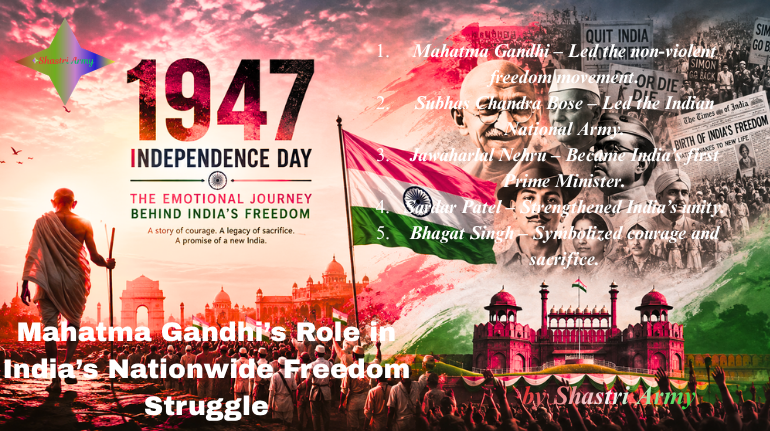
1947 Independence Day, The Inspiring : India’s Independence Day is celebrated every year on 15 August, but the meaning of this day goes far beyond flags, patriotic songs, parades, and public celebrations. 15 August 1947 marked a historic turning point when India emerged from nearly two centuries of British colonial rule and began its journey as an independent nation.
Behind that famous midnight moment was a long and deeply emotional struggle. Millions of Indians experienced sacrifice, imprisonment, poverty, protests, violence, hope, and loss. Farmers, students, workers, writers, soldiers, reformers, political leaders, and ordinary families all became part of a freedom movement that gradually transformed the idea of independence from a dream into reality.
The story of 1947 Independence Day is therefore not simply the story of a political transfer of power. It is the story of people who imagined a free India and endured extraordinary hardships to make that vision possible.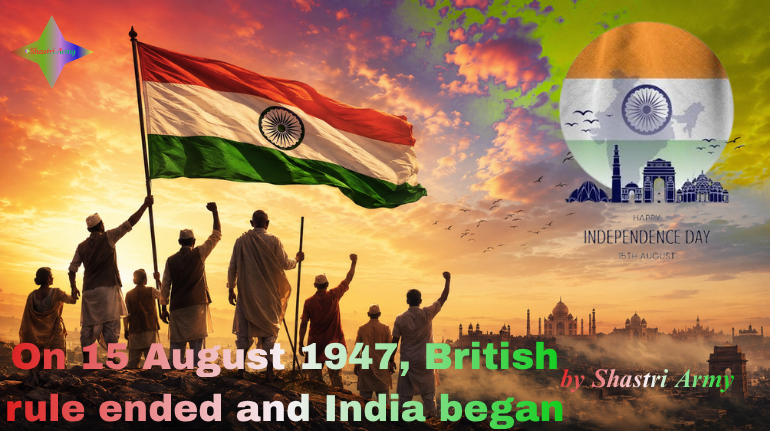
Why 15 August 1947 Became a Historic Day
15 August 1947 marked the historic moment when India gained freedom from British colonial rule. The British Parliament had passed the Indian Independence Act in July 1947, providing for the creation of two independent dominions, India and Pakistan.
The celebrations surrounding independence were filled with excitement, but they also carried a painful reality. The independence of British India came with the Partition of India, which divided the subcontinent and resulted in enormous human suffering.
For many people, independence represented freedom and a new beginning. For others, the same period brought separation from homes, displacement, uncertainty, and grief.
This complicated mixture of joy and sorrow makes 1947 Independence Day one of the most emotional chapters in modern Indian history.
The Long Road to Freedom
India’s freedom did not arrive suddenly in 1947. It was the result of decades of resistance and political awakening.
During British rule, Indians increasingly challenged colonial policies and demanded greater political representation and self-government. Early political organizations helped create a platform for these demands, while social and cultural movements encouraged people to think about national identity and independence.
The Indian National Congress, founded in 1885, gradually became one of the central organizations of the independence movement. Over time, the demand for limited political reforms developed into a much stronger demand for self-rule and complete independence.
The freedom struggle also included many individuals and groups with different philosophies. Some believed in constitutional methods, while others supported revolutionary action. This diversity shaped the movement and demonstrated how deeply the desire for freedom had spread.
The Emotional Impact of British Rule
To understand the emotional journey toward independence, it is important to recognize that colonial rule affected everyday life.
Economic policies transformed traditional industries and contributed to hardship in various communities. Farmers faced difficult revenue systems, while workers and artisans experienced changing economic conditions. Famines and poverty caused enormous suffering during different periods of British rule.
For ordinary Indians, political freedom was connected with the desire for dignity, economic opportunity, social justice, and control over their own future.
The freedom movement therefore became more than a political campaign. It became an emotional expression of national aspirations.
People began to ask an important question: Why should a foreign power decide the future of India?
That question became increasingly powerful with every generation.
Mahatma Gandhi’s Leadership and the Growth of India’s Mass Movements
The arrival of Mahatma Gandhi as a major leader transformed the nature of India’s freedom struggle.
Gandhi emphasized non-violence, civil disobedience, truth, and mass participation. Instead of limiting political resistance to educated elites, his movements encouraged ordinary people to participate.
The Non-Cooperation Movement, Civil Disobedience Movement, and Quit India Movement became major milestones in the struggle.
Gandhi’s approach encouraged people to challenge colonial authority through peaceful resistance. Boycotting foreign goods, promoting Indian-made products, refusing to cooperate with unjust systems, and participating in peaceful protests became important forms of political expression.
For many Indians, Gandhi represented the belief that courage did not always require physical violence. Standing firmly against injustice could itself become an act of strength.
The Salt March and the Power of Ordinary People
One of the most memorable moments of the freedom movement was the Salt March of 1930.
Gandhi and his followers marched to the coastal village of Dandi to protest the British monopoly and taxation of salt. Salt was an everyday necessity, making the issue understandable to ordinary people.
The significance of the march went beyond salt.
It showed how a simple everyday object could become a symbol of resistance. Thousands of people became involved in civil disobedience, and the movement attracted international attention.
The Salt March demonstrated that the freedom struggle was not merely taking place inside political offices. It was happening on roads, in villages, marketplaces, homes, schools, and communities across India.
Quit India Movement: India’s Final Push for Independence
Another major chapter came in 1942, when the Quit India Movement was launched.
The movement raised a powerful demand for India’s immediate freedom from British rule. Its powerful message of “Do or Die” reflected the determination of many Indians who believed that 1947 Independence Day could no longer be postponed.
British authorities responded with widespread arrests and repression. Many leaders were imprisoned, but the movement continued through underground activities and public resistance.
The events of the 1947 Independence Day made it increasingly difficult for Britain to ignore the strength of Indian nationalism.
World War II had also changed the global political and economic landscape. Britain emerged from the war weakened, while demands for independence across colonized regions became increasingly difficult to suppress.
Subhas Chandra Bose and the Revolutionary Spirit
The independence movement cannot be understood only through one political philosophy.
Subhas Chandra Bose, 1947 Independence Day ,popularly known as Netaji, represented a very different approach. He believed that armed struggle could play an important role in ending British rule.
His leadership of the Indian National Army (INA) became a powerful symbol of resistance.
The INDIA’s military campaign ultimately did not achieve its objective, but the trials of INA officers after World War II generated strong public sympathy in India.
For many people, the INA story strengthened the belief that Indians were willing to make extraordinary sacrifices for freedom.
The different paths followed by Gandhi, Bose, revolutionaries, constitutional leaders, social reformers, and countless unnamed citizens reflected the complexity of India’s independence movement.
The Role of Young Indians
Young people played a significant role throughout the freedom struggle.
Students participated in protests, boycotts, political campaigns, and underground activities. Young revolutionaries such as Bhagat Singh became powerful symbols of courage and sacrifice.
Bhagat Singh’s execution in 1931 deeply affected the Indian public and transformed him into one of the most remembered figures of the independence era.
His story continues to resonate because it represents the willingness of young people to sacrifice personal safety for a larger cause.
The freedom movement repeatedly demonstrated that patriotism was not limited by age.
Women Who Helped Shape the Freedom Struggle
Women also played an important role in India’s independence movement.
Figures such as Sarojini Naidu, Aruna Asaf Ali, Kasturba Gandhi, Kamala devi Chattopadhyay, Sucheta Kriplani, and many others contributed through protests, organizing, political work, social reform, and public leadership.
Thousands of women whose names were never recorded in history books also participated in demonstrations, supported underground networks, sheltered activists, and endured imprisonment.
Their contribution reminds us that independence was a collective struggle.
The emotional journey of 1947 Independence Day belonged not only to famous leaders. It belonged to mothers, daughters, wives, students, workers, and ordinary citizens who faced uncertainty while continuing to believe in a better future.
The Road to 1947 Independence Day
By the middle of the 1940, British rule was approaching its final stage.
Political negotiations intensified, but disagreements between major political organizations and communities made the situation increasingly complicated.
The demand for a separate Muslim homeland eventually became central to the political process. The result was the decision to partition British India into India and Pakistan.
Lord Mountbatten, the last Viceroy of India, announced the plan for the transfer of power. The original timetable was accelerated, and independence came in August 1947.
The political achievement was historic, but the human consequences were devastating.
Partition: The Pain Behind Independence
The Partition of 1947 Independence Day remains one of the most painful aspects of India’s independence story song.
Millions of people crossed newly created borders. Hindus, Muslims, and Sikhs were among those displaced from their homes.
Families were separated. Villages and neighborhoods changed overnight. Trains carried refugees across borders, while many people left behind homes, businesses, memories, and ancestral lands.
Communal violence caused enormous loss of life.
For countless families, independence did not begin with celebration. It began with fear, grief, displacement, and uncertainty.
This is why remembering 1947 requires sensitivity. The freedom of a nation and the suffering caused by Partition existed at the same time.
Jawaharlal Nehru’s Historic Midnight Speech
As independence approached, the Indian Constituent Assembly met in New Delhi.
At midnight between 14 and 15 August 1947 Independence Day, Jawaharlal Nehru delivered his famous speech commonly remembered as “Tryst with Destiny.”
The speech captured the historic significance of the moment. India was entering a new era, but the responsibilities of freedom were just beginning.
The emotional power of that night came from the knowledge that generations had struggled for the opportunity now arriving.
For people listening across the country, independence represented the possibility of a future shaped by Indians themselves.
The First 1947 Independence Day
India’s first Independence Day was unlike any celebration that followed.
There were ceremonies in Delhi, national flags were raised, and the atmosphere was filled with excitement. But across the newly independent country, millions were also dealing with the consequences of Partition.
The first day of freedom therefore contained two powerful emotions: celebration and mourning.
In Delhi, national leaders participated in official ceremonies. Elsewhere, refugees searched for safety and families tried to rebuild their lives.
This contrast is essential to understanding the emotional meaning of India’s first Independence Day.
The Indian Tricolor as a Symbol of Hope
The Indian national flag became one of the strongest symbols of the new nation.
The saffron, white, and green colors and the Ashoka Chakra represented ideals associated with courage, peace, progress, and righteousness.
For people who had lived under a colonial flag for generations, seeing the Indian Tricolor flying over government buildings carried extraordinary emotional significance.
The flag was no longer simply a piece of cloth. It represented freedom, identity, sacrifice, and national unity.
Even today, when millions of Indians raise the Tricolor on 1947 Independence Day, they participate in a tradition that began with the birth of independent India.
The Freedom Struggle Was Built on Sacrifice
It is easy to remember independence through famous names and major dates. But the real story is much larger.
Behind every movement were people who lost jobs, spent years in prison, suffered violence, gave up education, left their families, or risked their lives.
Many freedom fighters never became famous.
Some sacrificed everything without knowing whether they would live to see independence.
That makes the achievement of 1947 Independence Day even more meaningful.
Freedom was not free. It was built through courage, patience, sacrifice, and an extraordinary belief in the future.
What Independence Meant to Ordinary Indians
For an ordinary Indian in 1947, independence could mean different things.
For a farmer, it might mean hope for a fairer future.
For a student, it could represent the opportunity to build a new nation.
For a worker, it could mean dignity and greater economic opportunity.
For a family separated by Partition, however, independence might have been accompanied by deep personal loss.
This diversity of experiences makes the story of 1947 deeply human.
History is not only about governments and political agreements. It is also about individual lives changed by enormous events.
Independence and the Birth of a New Responsibility
Winning independence was only the beginning.
India faced enormous challenges after 1947, including refugee rehabilitation, economic development, communal tensions, poverty, education, public health, and the creation of democratic institutions.
The country eventually adopted its Constitution, which came into effect on 26 January 1950 and established India as a republic.
The freedom struggle had demanded political independence, but the next challenge was to make freedom meaningful in everyday life.
That meant building institutions, protecting rights, expanding education, improving living standards, and creating opportunities for citizens.
Why 1947 Still Matters Today
More than seven decades after independence, the emotional importance of 1947 remains strong.
Every 1947 Independence Day gives Indians an opportunity to remember the people who fought for freedom and to think about the responsibilities that come with it.
The country has changed enormously since 1947. India has developed its economy, expanded education, built major scientific and technological capabilities, and established itself as an important country on the world stage.
Yet the ideals behind independence remain relevant.
Freedom requires responsibility. Democracy requires participation. Unity requires understanding. Progress requires effort.
Remembering 1947 Independence Day should therefore inspire people not only to celebrate the past but also to contribute to the future.
How Independence Day Is Celebrated Today
Modern Independence Day celebrations combine tradition, patriotism, remembrance, and public participation.
The Prime Minister traditionally hoists the national flag at the Red Fort in New Delhi and addresses the nation.
Schools and colleges organize flag-hoisting ceremonies, cultural programs, patriotic songs, speeches, debates, and competitions.
Families decorate their homes, communities organize events, and people share Independence Day messages across social media.
The Tricolor becomes visible across cities, towns, villages, public institutions, and homes.
While the celebrations have become more modern, their central purpose remains unchanged: to remember the journey that made freedom possible.
The Emotional Meaning of Independence for the Next Generation
Young Indians today were born into an independent country. They have never experienced colonial rule.
That is a remarkable achievement in itself.
However, because freedom is now part of everyday life, it can sometimes be easy to forget how extraordinary the journey was.
Learning about 1947 Independence Day helps younger generations understand that democratic rights and national independence were not simply handed over without struggle.
They were shaped by generations of people who imagined a different future.
The responsibility of the younger generation is therefore not to repeat the past but to protect the values that make freedom meaningful.
Lessons From India’s Journey to Independence
The story of 1947 offers several powerful lessons.
First, collective action can create historic change.
Second, courage can take many forms. It can appear through peaceful protest, political organization, social reform, education, journalism, military resistance, or simply refusing to accept injustice.
Third, freedom and responsibility are connected. Political independence creates opportunities, but citizens must use those opportunities wisely.
Finally, history teaches us the importance of remembering human suffering. The celebrations of independence should not erase the pain experienced during Partition.
A mature understanding of history can hold both emotions together: pride in freedom and compassion for those who suffered.
15 August 1947: A Date That Changed India Forever
There are certain dates that become permanently connected with the identity of a nation.
1947 Independence Day For India, 15 August 1947 is one of them.
It marks the end of British colonial rule and the beginning of a new national journey.
But the emotional power of the date comes from everything that came before it: decades of political struggle, countless protests, imprisonment, sacrifice, revolutionary action, social movements, negotiations, and personal hardships.
It also carries the memory of Partition and the millions whose lives were transformed by the creation of new borders.
That is why Independence Day should be remembered with both celebration and reflection.
Conclusion
1947 Independence Day was the beginning of a new chapter in Indian history, but its emotional story began long before the Tricolor was raised in August 1947. Generations of Indians contributed to the freedom movement in different ways, carrying a shared dream of a country that could determine its own destiny.
The road to freedom was filled with extraordinary courage, but it was also marked by sacrifice and tragedy. The celebrations of independence stood alongside the heartbreaking reality of Partition, reminding us that history is rarely simple.
Today, 15 August is more than a national holiday song desh bhakti geet. It is a reminder of the people who dreamed of freedom, the individuals who sacrificed for it, and the responsibilities that come with living in an independent nation.
As the Tri color rises into the sky each Independence Day, its meaning can be summed up in a simple thought: India’s freedom was won through the courage of many, and its future is shaped by the responsibility of every generation.