














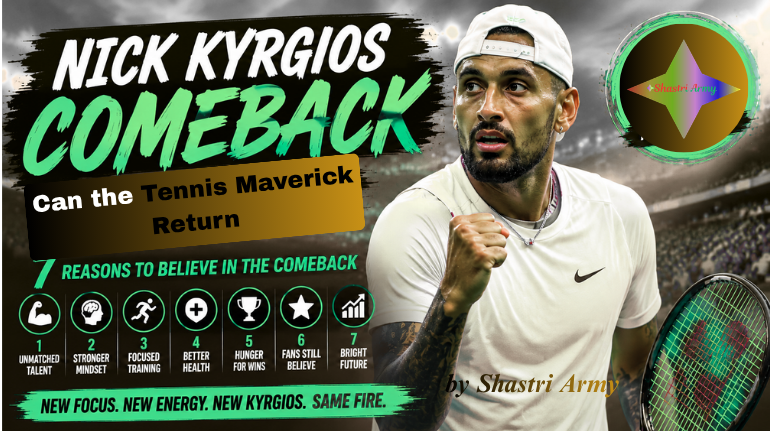
Nick Kyrgios Comeback: Nick Kyrgios has always been one of the most fascinating figures in modern tennis. Few players can combine explosive serving, outrageous shot-making, emotional intensity and natural showmanship quite like the Australian. At his peak, Kyrgios looked capable of beating virtually anyone on the right day. His career-high singles ranking of World No. 13, seven ATP singles titles and 2022 Wimbledon final appearance provide plenty of evidence that his talent was never the problem.
The bigger issue has always been consistency, health and staying on the court. Injuries have repeatedly interrupted his career, and long periods away from competitive tennis have made it difficult for him to build momentum. In 2026, he showed once again that his tennis ability has not disappeared, winning a singles match on grass after a lengthy absence. However, the comeback story took another unexpected turn when he was provisionally suspended following a positive cocaine test connected to the Mallorca tournament.
That development makes the question even more complicated: Can Nick Kyrgios return to his best? The answer depends on what “best” means. If it means producing spectacular tennis capable of defeating elite opponents, the evidence suggests that remains possible. If it means returning to the level of consistency required to challenge for Grand Slam titles week after week, the road is much harder.
Kyrgios does not need to become the same player he was in his twenties. He needs to become a healthier, more disciplined and strategically smarter version of himself. His serve, creativity and experience remain valuable weapons. The real battle is whether his body and circumstances will allow those weapons to be used consistently again.
From Teenage Sensation to Wimbledon Finalist
Nick Kyrgios Comeback announced himself to the tennis world with an extraordinary run at Wimbledon in 2014. Ranked outside the top 100, he defeated Rafael Nada and reached the quarter-finals, immediately establishing himself as a player capable of producing enormous upsets. The performance was not simply a lucky tournament. It showed that Kyrgios possessed rare confidence, power and creativity at an extremely young age.
His career continued to develop, and in 2016 he reached his career-high singles ranking of No. 13. He eventually collected seven ATP singles titles and became one of the most recognizable personalities on the tour. Yet there was always a feeling that something even bigger was possible.
That possibility became reality, at least temporarily, in 2022. Nick Kyrgios Comeback reached his first Grand Slam singles final at Wimbledon, where he faced Novak Djokovic. He won the opening set but Djokovic recovered to win 4–6, 6–3, 6–4, 7–6(7–3).
The Wimbledon run was important because it changed the conversation around Kyrgios. Before 2022, critics could argue that he had enormous talent but had never converted it into a sustained Grand Slam challenge. Reaching the final answered that criticism. He had demonstrated that, when motivated and physically capable, he could compete deep into a major tournament.
That is why the comeback conversation refuses to disappear. Tennis fans have already seen what Kyrgios can do when everything comes together.
The 2022 Season Proved His Ceiling Was Extremely High
The 2022 season was arguably the clearest demonstration of Nick Kyrgios Comeback potential. He won the Australian Open men’s doubles title with Thanasi Okinawan, captured the Washington singles title and reached the Wimbledon singles final. The ATP notes that he recorded 61 total victories across singles and doubles during the season.
His singles performance was especially impressive because he was not simply relying on one hot tournament. He produced strong results throughout the season and defeated Daniil Medevac at the US Open before reaching the quarter-finals there.
The Djokovic rivalry also tells an interesting story. Kyrgios won their first two meetings, at Acapulco and Indian Wells in 2017, before Djokovic finally defeated him in the Wimbledon final.
That record illustrates why Kyrgios has always been dangerous against elite opposition. His style can disrupt players who normally control matches through rhythm and repetition. A huge serve can prevent an opponent from building scoreboard pressure, while his unpredictable shot selection can make established tactical patterns suddenly irrelevant.
The question is whether that peak can be recreated after years of interruptions.
Injuries Have Become the Biggest Obstacle
Kyrgios’ biggest opponent may not be another tennis player. It may be his own body.
His recent career has been heavily affected by physical problems. The ATP records knee surgery in January 2023, while Kyrgios has spoken about the enormous physical toll of his injuries. Reports in 2026 also highlighted his wrist reconstruction and multiple knee surgeries.
For a tennis player, repeated injuries create a difficult cycle. First comes the physical problem, followed by rehabilitation. Then comes the attempt to regain fitness. After that, the player must rebuild match confidence. Just when momentum begins to return, another physical setback can send everything backwards.
That cycle is particularly damaging for someone whose game depends on explosive movement and powerful serving.
Nick Kyrgios Comeback is 31 years old in 2026. That is not old for a professional tennis player, but it is a very different physical stage from the one he occupied when he was a teenager upsetting Nada. Recovery becomes more important, workload must be managed carefully and every tournament needs to be considered in terms of long-term fitness.
A successful Nick Kyrgios Comeback therefore cannot simply involve training harder. Kyrgios needs a sustainable physical plan that allows him to compete without constantly pushing his body beyond its limits.
His 2026 Comeback Showed the Talent Is Still There
The most encouraging part of the 2026 story was his return to singles competition. After long periods away, Kyrgios eventually stepped onto the grass in Stuttgart and defeated Continent Moutet in straight sets. The victory was significant because it provided tangible evidence that he could still win an ATP-level singles match.
One victory does not prove that a complete comeback has arrived. However, it can provide something incredibly valuable to an injured athlete: belief.
Imagine spending months or years wondering whether your body will ever allow you to compete again. Then you step onto a professional court and win. Suddenly, the possibility becomes real again.
That psychological shift can be powerful.
Kyrgios’ Stuttgart appearance also reminded fans why his game is so difficult to ignore. His serve can immediately put pressure on an opponent, while his ability to change pace and direction creates uncertainty. Even after a long absence, the underlying skills remain.
The challenge is turning one victory into ten, ten into twenty, and eventually into a complete season.
Why Kyrgios’ Serve Could Be the Key to His Comeback
If there is one weapon that could help Kyrgios extend his career, it is his serve.
A powerful serve can reduce the amount of physical work required during a match. Winning quick service points means fewer extended baseline exchanges. Holding serve comfortably also allows a player to put more pressure on the opponent during return games.
Kyrgios has built much of his career around that principle. He can serve at huge speeds, disguise placement and use different types of serves to prevent opponents from settling into predictable patterns.
That becomes particularly important as players age or return from injuries. Kyrgios does not need to run around the court for every point if he can consistently control matches with his first strike.
His serve can also make him dangerous in Grand Slam tournaments. On faster courts, especially grass, a player with a huge serve can stay competitive against opponents who may be superior in long rallies.
The challenge is making sure the rest of his body can support that serve. Serving at the highest level repeatedly requires coordinated movement through the legs, hips, trunk, shoulder and wrist. His physical team will therefore need to protect the entire kinetic chain rather than focusing on one injury at a time.
His Creativity Remains a Major Weapon
Kyrgios is not dangerous simply because he hits hard. He is dangerous because opponents never know exactly what he might do next.
He can hit a conventional serve, then surprise an opponent with an underarm serve. He can attack a second serve, suddenly use a drop shot or attempt a spectacular passing shot. His hands are naturally gifted, allowing him to produce angles that many players would not even attempt.
That creativity has enormous value against modern opponents.
Tennis has become increasingly analytical. Players study patterns, tendencies and percentages. Coaches prepare detailed game plans for opponents. But a player like Kyrgios can disrupt those plans because he is willing to choose shots outside the expected pattern.
The danger is that creativity without discipline can become self-defeating. A comeback version of Kyrgios may need to make smarter decisions about when to take risks.
The goal should not be to eliminate his personality or creativity. It should be to make those qualities more efficient.
Can He Compete With the New Generation?
The modern ATP Tour is packed with young players who are extremely athletic and tactically sophisticated. The generation following the sport’s Big Three era has developed powerful serves, aggressive returns and exceptional defensive movement.
Kyrgios cannot expect to beat these players simply by trying to outlast them from the baseline.
His advantage must come from contrast.
He can shorten rallies, attack early and create scoreboard pressure with his serve. He can force opponents to play uncomfortable tiebreaks. He can use changes of pace to stop them from settling into rhythm.
His experience is another advantage. Kyrgios has already faced Djokovic, Nodal, Federer and many other elite players. He understands what it feels like to play under enormous pressure.
That experience could become increasingly valuable if he returns.
The Mental Challenge May Be Bigger Than the Physical One
A professional athlete’s body can be rehabilitated through structured training. The mind is more complicated.
Kyrgios has been open about the emotional difficulties he has experienced during his career. His recent statement after the provisional suspension described the physical and mental toll associated with his injuries and the possibility that his career could be nearing its end.
That context matters because motivation is central to a Nick Kyrgios Comeback.
Why return after everything that has happened?
Why go through another rehabilitation cycle?
Why travel around the world, train every day and deal with pressure when retirement could provide a quieter life?
Kyrgios needs his own answers to those questions. Fans can want a comeback, sponsors can want a comeback and the tennis world can want a comeback, but none of that matters if the player himself does not genuinely want it.
A successful return will probably require him to rediscover enjoyment rather than simply chase rankings.
The Current Suspension Changes Everything
The latest development makes Nick Kyrgios Comeback much more complicated.
In August 2026, the International Tennis Integrity Agency announced that Kyrgios had been provisionally suspended after testing positive for benzoylecgonine, a metabolite of cocaine, from a sample collected at the ATP 250 event in Mallorca on June 22. His provisional suspension began on August 4.
Kyrgios publicly acknowledged the positive test and described the incident as a serious mistake. He also announced that he would step away from public life for 28 days to focus on recovery and asked for privacy.
This is obviously a major setback.
The comeback had already been difficult because of injuries and limited match play. Now there is another interruption, and the focus has temporarily shifted from tennis performance to personal responsibility and the disciplinary process.
It is important not to confuse the suspension with the end of his tennis career. The ultimate impact depends on the relevant anti-doping process and the eventual length of the suspension.
What happens next will matter enormously.
Could the Suspension End His Tennis Career?
It is possible, but it is far too early to say that Kyrgios’ career is over.
The 31-year-old has already experienced long periods away from competitive tennis. He has shown that he can return after substantial setbacks, although the latest situation is different because it involves an integrity matter rather than only physical injury.
The most important question is whether Kyrgios still wants to compete.
If he does, the suspension could become a period for reflection and rebuilding. If he decides that the physical and emotional costs have become too high, retirement would also be understandable.
The decision ultimately belongs to him.
Tennis has seen athletes return from major setbacks before. Careers can take unexpected turns. A player can appear finished one year and produce an extraordinary season later.
That does not mean a comeback is guaranteed. It simply means that the story is not necessarily finished.
What Would a Successful Kyrgios Comeback Look Like?
The definition of success needs to change.
If Kyrgios returns expecting to immediately reach another Grand Slam final, the pressure could become overwhelming. A healthier approach would be to establish smaller milestones.
The first goal should be staying healthy.
The second should be playing regularly.
The third should be winning matches consistently.
The fourth should be rebuilding his ranking.
Only after those stages should Grand Slam ambitions become the primary focus.
The current ITF profile lists Nick Kyrgios Comeback at No. 910 in the singles rankings as of July 20, 2026, while his career-high remains No. 13. That enormous gap shows how much work would be required.
But rankings can change quickly when a player has a strong run.
A few tournament victories could provide a significant boost, particularly if Kyrgios receives wild cards or other opportunities to enter higher-level events.
Can Nick Kyrgios Return to the Top 20?
A top-20 comeback would be extremely difficult, but it cannot be dismissed entirely.
The strongest argument in his favor is historical evidence. Kyrgios has already reached No. 13, meaning the required tennis level is not theoretical. He has proven it against the world’s best players.
The argument against him is consistency.
Top-20 players do not simply produce brilliant performances occasionally. They accumulate wins throughout the season. They travel, recover and compete repeatedly. They must handle opponents who know exactly what they are going to do.
Kyrgios would need a sustained period without major injuries and with enough tournament participation to accumulate ranking points.
A return to the top 50 would probably be a more immediate and realistic benchmark. If he reaches that level and remains healthy, the top 20 could become a long-term possibility.
Why Wimbledon Could Be His Best Opportunity
Wimbledon is perhaps the tournament most naturally suited to Kyrgios’ style.
Grass rewards serving, attacking and taking the ball early. The lower bounce can make life uncomfortable for traditional baseline players. Points can be shorter, which can help an athlete who needs to protect his body.
Kyrgios also has a strong history at Wimbledon.
His 2014 breakthrough came there, and his 2022 run ended in the final against Djokovic. The tournament is therefore deeply connected to his identity as a player.
A future Wimbledon comeback would also carry enormous emotional weight.
Imagine Kyrgios returning to Centre Court after everything he has experienced. The crowd would be intensely interested, but the challenge would be enormous. He would need sufficient match preparation, physical confidence and mental stability.
Nostalgia can create a wonderful atmosphere, but it cannot win seven matches.
Kyrgios would still need to produce the tennis.
Why Fans Continue to Believe in Him
Kyrgios has something few tennis players possess: genuine unpredictability.
When he plays, people watch because something unexpected might happen.
That does not necessarily mean controversy. It can mean a ridiculous winner, an impossible angle, an extraordinary serve or a sudden tactical decision.
He has become a character in tennis culture, not merely a ranking number.
That is why fans continue to discuss his career even when he is not playing regularly. His Wimbledon final appearance created a lasting connection with audiences, while his partnership with Okinawan also produced memorable doubles moments.
His appeal is partly based on personality, but his supporters also know that underneath the personality is an extraordinary tennis player.
That combination makes his potential comeback compelling.
The Importance of Doubles
Doubles could also play a role in Kyrgios’ future.
His partnership with Thanasi Okinawan produced the 2022 Australian Open men’s doubles title, demonstrating that Kyrgios can be highly effective in a doubles environment.
Doubles can provide competitive intensity while sometimes placing different physical demands on a player. It can also help a returning athlete rediscover timing, reactions and match instincts.
For Kyrgios, doubles has another benefit: enjoyment.
Playing alongside a trusted partner can make competition feel less like a solitary battle. If he is trying to rebuild his relationship with tennis, that emotional component could matter.
However, singles will remain the clearest test of whether he can return to elite competition.
The Biggest Obstacles Ahead
There are several major obstacles between Kyrgios and another serious singles comeback.
Physical health is number one. Without a stable body, everything else becomes irrelevant.
Match fitness is another problem. Training can prepare an athlete, but competitive tennis creates a different kind of fatigue.
Ranking position creates practical difficulties. A low ranking can mean qualifying rounds, fewer direct entries and dependence on wild cards.
Mental resilience will also be crucial. Every comeback match can create enormous media attention, and every loss can trigger questions about whether the player is finished.
Consistency may be the biggest sporting challenge of all. Kyrgios has already demonstrated that he can produce elite tennis. The question is whether he can reproduce it regularly.
Finally, the current suspension adds uncertainty that no tennis training plan can solve.
A Realistic Path Back
If Kyrgios decides to continue his professional career, the smartest route would be gradual.
He should not attempt to play an overloaded schedule immediately after returning. His body needs time to adapt to competition.
The first stage should involve controlled training and physical rehabilitation. The second should involve limited competition. The third should involve gradually increasing match volume.
Once he is consistently completing matches without physical setbacks, the focus can shift toward ranking points.
The important thing is not to chase the past.
Kyrgios cannot control what happened in 2016, 2022 or 2024. He can only control what happens next.
A comeback is not about recreating history. It is about building a new version of the career.
Can the Tennis Maverick Return to His Best?
Yes, Nick Kyrgios can still return to a very high level of tennis, but returning to his absolute career peak will be extremely difficult.
His talent is not in doubt. His seven ATP singles titles, career-high ranking of No. 13 and Wimbledon final appearance demonstrate that. His 2026 victory over Moutet also showed that, when he gets onto the court, the competitive ability remains.
But talent is only one part of professional sport.
His body has suffered years of injuries. His ranking has fallen dramatically. His competitive rhythm has been interrupted. And the August 2026 provisional suspension has created another major challenge.
The most realistic goal is not to demand that Kyrgios immediately become a Grand Slam finalist again.
The first goal should be stability.
Then health.
Then regular competition.
Then ranking improvement.
After that, perhaps, the big tournaments.
If he can rebuild those foundations, his serve and creativity could still make him one of the most uncomfortable opponents on the ATP Tour.
And that is what makes the Kyrgios comeback story so intriguing.
The old Nick Kyrgios Comeback was a spectacular talent who sometimes seemed to fight against his own potential. The next version could be different: more selective, more experienced and more aware of what his body requires.
Whether that version ever appears is the great unanswered question.
For now, his tennis career remains uncertain. But if Kyrgios eventually returns, fans will not simply be watching another player come back from injury. They will be watching one of tennis’ most unpredictable characters attempt to write a completely new final chapter.
Frequently Asked Questions About Nick Kyrgios’ Comeback
1. What is Nick Kyrgios’ highest ATP singles ranking?
Nick Kyrgios reached a career-high singles ranking of World No. 13 on October 24, 2016. His ranking later fell significantly after extended periods of limited competition and injury.
2. Did Nick Kyrgios reach a Grand Slam final?
Yes. Kyrgios reached the 2022 Wimbledon men’s singles final, his first Grand Slam singles final. He lost to Novak Djokovic in four sets, 4–6, 6–3, 6–4, 7–6(7–3).
3. Why has Nick Kyrgios played so little tennis recently?
A major reason has been injuries. Nick Kyrgios Comeback has undergone significant procedures, including knee surgery and wrist reconstruction, while spending extended periods away from competitive tennis.
4. Is Nick Kyrgios currently suspended from tennis?
Yes. As of August 20, 2026, Kyrgios is under a provisional suspension after a positive test for benzoylecgonine, a metabolite of cocaine, connected to a sample collected at the Mallorca ATP event on June 22. The suspension began August 4, 2026.
5. Can Nick Kyrgios return to the top of tennis?
A return to the very top is possible but highly uncertain. His previous career demonstrates that he has the ability to compete with elite players, but his health, match fitness, ranking position, mental readiness and current disciplinary situation create significant obstacles. A sustained return would require patience and consistency rather than one spectacular tournament.
6. Why is Wimbledon particularly important to Kyrgios?
Wimbledon is where Nick Kyrgios Comeback announced himself as a major talent in 2014 and where he reached his first Grand Slam final in 2022. Grass also suits several of his strengths, particularly his powerful serve and aggressive first-strike style.
7. Could Kyrgios play doubles again?
Yes, doubles has already been an important part of his career. He won the 2022 Australian Open men’s doubles title with Thanasi Okinawan, and doubles could potentially provide another competitive pathway if he chooses to continue playing.
8. What is the biggest challenge facing Kyrgios now?
The biggest challenge is rebuilding stability. He needs to address his physical condition, regain competitive rhythm and navigate the consequences of his current suspension. His tennis ability remains a major asset, but the foundation around that talent must become much more reliable.
9. Has Kyrgios already shown signs of a comeback in 2026?
Yes. Nick Kyrgios Comeback He returned to ATP-level singles competition in 2026 and defeated Continent Moutet on grass in Stuttgart, providing an encouraging sign that his competitive tennis remained effective after a long absence.
10. What would make a Kyrgios comeback successful?
A successful Nick Kyrgios Comeback should begin with health and consistency, not immediately with Grand Slam titles. If Kyrgios can stay healthy, play regularly, rebuild his ranking and defeat strong opponents over an extended period, he can consider the comeback a success. A return to the top 20 or another deep Grand Slam run would then become a much more realistic ambition.