


















Solar Eclipses Explained: A solar eclipse is one of the most fascinating events that can happen in the daytime sky. For a short period, the Moon moves between the Earth and the Sun, blocking some or all of the Sun’s light from reaching certain parts of our planet. Depending on the alignment, people may see the Sun partially covered, completely hidden, or surrounded by a bright ring.
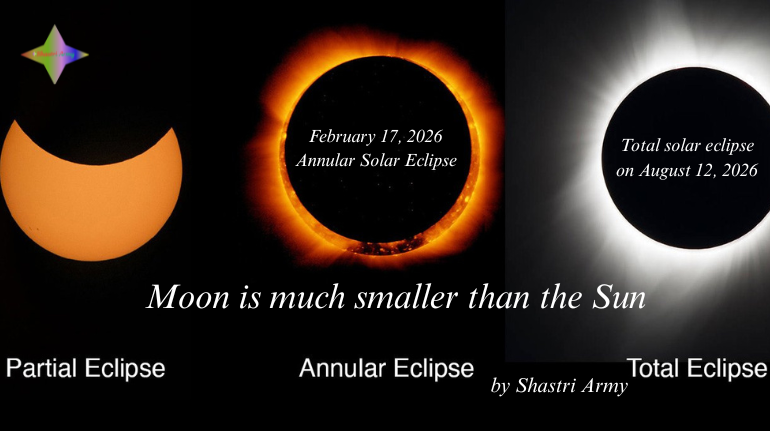
Sky watchers have two solar eclipses to look forward to in 2026. The first will be an annular solar eclipse on February 17, while the second will be a total solar eclipse on August 12.
Unfortunately, neither of the two solar eclipses in 2026 will be visible from India.
February 17, 2026 – Annular Solar Eclipse
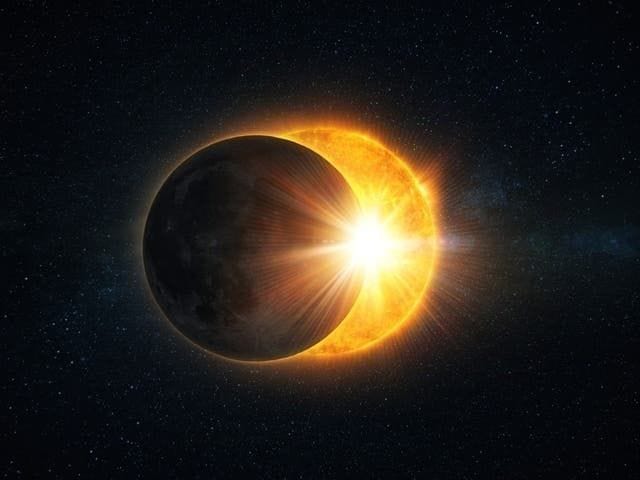
The first solar eclipse of 2026 will be an annular eclipse, also known as a “ring of fire” eclipse. During this event, the Moon will pass in front of the Sun but will appear slightly smaller, leaving a bright ring of sunlight around its edge.
Unfortunately for Indian sky watchers, this eclipse will not be visible from India. The event will be observable from selected parts of the Southern Hemisphere and nearby regions.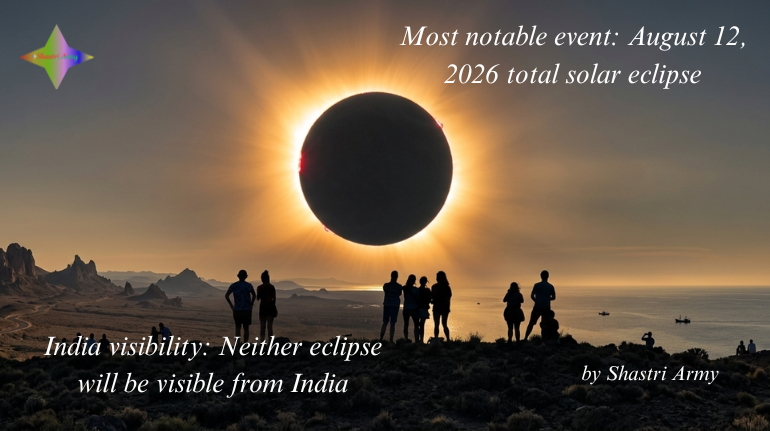
August 12, 2026 – Total Solar Eclipse
The second solar eclipse of 2026 will be a total solar eclipse on August 12. This will be the more dramatic of the two events because the Moon will completely cover the Sun for observers within the path of totality.
The total eclipse will be visible from parts of Greenland, Iceland, Spain and northern Russia, along with other areas along the eclipse path.
For people in India, however, there is disappointing news: the August 12 total solar eclipse will not be visible from India.
Will India See a Solar Eclipse in 2026?
No. Neither of the two solar eclipses in 2026 will be visible from India.
Indian viewers who want to experience a Solar Eclipses Explained will therefore need to wait for a future event or follow the 2026 eclipses through safe online broadcasts and astronomy coverage.
Solar Eclipse 2026: Quick Facts
- February 17, 2026: Annular solar eclipse
- August 12, 2026: Total solar eclipse
- India visibility: Neither eclipse will be visible from India
- Most notable event: August 12 total solar eclipse
For Indian astronomy enthusiasts, 2026 may not bring a visible solar eclipse, but it still promises two interesting celestial events worth following. The August total eclipse, in particular, will attract attention because of its path across several regions and the spectacular view of the Sun’s corona during totality.
Solar Eclipses Explained have attracted human attention for thousands of years. In ancient times, people often viewed a sudden change in daylight as mysterious or frightening. Today, astronomers understand exactly why eclipses occur, but seeing one in person can still be an unforgettable experience.
Solar eclipses are generally divided into four types: total, partial, annular, and hybrid. The type people see depends on the alignment of the Sun, Moon, and Earth and the Moon’s distance from Earth.
Here are 10 amazing facts that explain what makes solar eclipses so special.
What Is a Solar Eclipse?
A solar eclipse occurs when the Moon passes between the Sun and Earth, causing the Moon’s shadow to fall across part of Earth’s surface. People inside different portions of that shadow can see different types of Solar Eclipses Explained.
A Solar Eclipses Explained can happen only during a new Moon, but not every new Moon produces an eclipse. The Moon’s orbit is tilted relative to Earth’s orbit around the Sun, so the three objects do not line up perfectly every month.
1. The Sun and Moon Can Appear Almost the Same Size
The Moon is much smaller than the Sun, yet during a total solar eclipse, it can appear large enough to block the Sun entirely.
The reason is distance. The Sun is much larger than the Moon, but it is also much farther away from Earth. The Moon is much smaller but much closer to us. From Earth’s surface, their apparent sizes can therefore be similar.
When the geometry is just right, the Moon can cover the bright disk of the Sun and reveal the Sun’s outer atmosphere. This unusual size-and-distance relationship is a major reason total Solar Eclipses Explained are possible.
2. Solar Eclipses Don’t Happen Every Month
At first, it might seem strange that Solar Eclipses Explained aren’t a monthly event.
After all, the Moon completes its cycle around Earth roughly once a month. Every new Moon puts the Moon between Earth and the Sun. However, the Moon’s orbital path is tilted by about five degrees compared with Earth’s orbital plane around the Sun.
Because of that tilt, the Moon usually passes slightly above or below the Sun from our perspective. An eclipse happens only when the Moon reaches the right part of its orbit and the Sun, Moon, and Earth line up closely enough. These periods occur during what astronomers call eclipse seasons.
3. There Are Four Types of Solar Eclipses Explained
Solar eclipses come in four main varieties.
Total Solar Eclipse
A total solar eclipse occurs when the Moon completely covers the bright face of the Sun for observers located in the Moon’s central shadow.
The daytime sky can become dramatically darker, and the Sun’s corona may become visible around the Moon.
Partial Solar Eclipse
A partial Solar Eclipses Explained occurs when the Moon covers just part of the Sun’s disk.
The Sun may appear to have a crescent-shaped portion missing. A partial eclipse can be visible across a much wider region than the narrow path of totality.
Annular Solar Eclipse
An annular solar eclipse occurs when the Moon looks slightly smaller than the Sun from Earth.
The Moon passes in front of the Sun without completely hiding its bright disk. A bright circle of sunlight remains visible around the Moon, creating the famous “ring of fire” appearance.
Hybrid Solar Eclipse
A hybrid solar eclipse is much rarer. Depending on the observer’s position, the eclipse can appear total in some locations and annular in others.
This happens because of Earth’s curved surface and the geometry of the Moon’s shadow.
4. Totality Is the Most Dramatic Part
For people lucky enough to be inside the path of totality, the most dramatic moment is totality.
This is the brief period when the Moon completely covers the Sun’s bright surface.
The surroundings can become surprisingly dark, and the atmosphere may feel different as daylight suddenly fades. The Sun’s corona can appear around the dark silhouette of the Moon.
Because totality is visible only along a relatively narrow path, people sometimes travel long distances to experience it.
The exact duration varies from eclipse to Solar Eclipses Explained and from location to location.
5. The Sun’s Corona Becomes Visible
The corona is the Sun’s outer atmosphere.
Under normal conditions, the bright surface of the Sun overwhelms the much fainter corona. During totality, however, the Moon blocks the bright solar disk, making the corona easier to see.
It can look like a delicate, glowing halo surrounding the Moon.
The corona isn’t just beautiful. It is also scientifically important. Researchers study it to understand the Sun’s atmosphere, magnetic activity, and solar wind. NASA notes that total solar eclipses provide unique opportunities to observe the corona.
6. The Moon’s Shadow Moves Across Earth
When the Moon blocks sunlight, it creates a shadow that moves across Earth’s surface.
The darkest central part of the shadow is called the umbra. Observers within this region can experience totality when the eclipse geometry allows it.
A lighter region called the penumbra surrounds the umbra. People within the penumbra may see a partial Solar Eclipses Explained.
As the Moon moves in its orbit and Earth rotates, its shadow shifts across the planet. This is why a total eclipse is visible only along a specific path.
For eclipse watchers, finding a location inside that path can make the difference between seeing a partial eclipse and experiencing totality.
7. Solar Eclipses Can Change the Daytime Environment
A strong Solar Eclipses Explained can create noticeable changes in the environment.
As sunlight decreases, temperatures may drop, shadows can become unusual, and the landscape may take on a twilight-like appearance during a total eclipse.
Some animals can also respond to the sudden change in light. Birds and insects, for example, may alter their behavior when daytime suddenly becomes darker.
These reactions are not necessarily identical everywhere. Weather, species, location, and the amount of sunlight blocked can all influence what people observe.
Still, the sudden transformation of the environment is one of the reasons total solar eclipses feel so unusual.
8. Eclipses Have Helped Scientists Study the Sun
Solar Eclipses Explained are not only beautiful events for skywatchers. They also provide valuable opportunities for scientific research.
During totality, scientists can study parts of the Sun’s atmosphere that are normally difficult to observe from Earth.
Researchers can investigate the structure and behavior of the corona and improve our understanding of solar activity. Modern space missions continuously monitor the Sun, but a total solar eclipse provides a special natural observing opportunity. Scientists can combine eclipse observations with data from spacecraft and other instruments to learn more about our nearest star.
The August 12, 2026 total solar eclipse, for example, attracted major scientific interest, including NASA observations designed to study the Sun and Earth’s atmosphere.
9. Solar Eclipses Can Create Amazing Shadow Effects
An eclipse doesn’t only change what happens in the sky. It can also create unusual patterns of light and shadow on the ground. During a partial Solar Eclipses Explained, tiny gaps between leaves can act like natural pinhole cameras. Instead of projecting normal circular images of the Sun, they can produce small crescent-shaped images as the Moon covers part of the solar disk.
The effect can be surprisingly beautiful.
During some total eclipses, observers may also notice rapidly moving shadow patterns known as shadow bands shortly before or after totality.
These effects are a reminder that an eclipse changes the way sunlight interacts with everything around us.
10. Watching a Solar Eclipse Safely Is Extremely Important
The most important fact about any Solar Eclipses Explained is that you should never look directly at the Sun without proper solar eye protection, except during the brief total phase of a total eclipse when the Moon completely covers the Sun’s bright face.
Regular sunglasses are not safe for direct solar viewing.
During partial and annular eclipses, specialized eclipse glasses or other approved solar viewing equipment should be used. The same protection is required during the partial phases of a total eclipse, before and after totality.
Extra caution is needed when using cameras, binoculars, or telescopes. Looking at the Sun through optical equipment without a proper solar filter can cause severe eye injury.
For people without suitable equipment, indirect methods such as a simple pinhole projector can provide a safer way to observe the changing shape of the Sun.
Why Do People Love Solar Eclipses?
Part of the attraction comes from the rarity and beauty of the event.
A normal sunny day can suddenly change. The light becomes strange, shadows behave differently, and during totality the sky can become dramatically dark.
There is also something exciting about knowing that what you are watching is happening because of the precise movement of three enormous celestial bodies.
The experience can make astronomy feel much more real. Instead of simply reading about the Moon’s orbit or Earth’s movement around the Sun, you can actually see the result of those movements in the sky.
Solar Eclipses and Human History
People have been recording eclipses for centuries.
Before modern astronomy, a sudden disappearance of sunlight could be difficult to explain. Different cultures developed their own stories and beliefs about these unusual events.
As astronomy developed, scientists gradually learned that eclipses could be predicted using mathematics and observations of celestial motion.
Today, eclipse predictions can be calculated years in advance. People can determine where an eclipse will occur, how much of the Sun will be covered, and when different stages will begin and end.
That combination of ancient fascination and modern science makes eclipses especially interesting.
Frequently Asked Questions About Solar Eclipses Explained
What causes a solar eclipse?
A Solar Eclipses Explained happens when the Moon passes between the Sun and Earth and blocks some or all of the Sun’s light from reaching certain areas of Earth.
How many types of solar eclipses are there?
There are four main types: total, partial, annular, and hybrid solar eclipses.
Why doesn’t a solar eclipse happen every month?
The Moon’s orbit is tilted relative to Earth’s orbit around the Sun. As a result, the Moon usually passes above or below the Sun during the new Moon phase instead of lining up precisely with it.
What is a total solar eclipse?
A total solar eclipse occurs when the Moon completely covers the bright face of the Sun for observers within the Moon’s central shadow.
What is an annular solar eclipse?
An annular eclipse happens when the Moon appears smaller than the Sun and leaves a bright ring of sunlight visible around it.
Can I look at a solar eclipse with normal sunglasses?
No. Normal sunglasses do not provide sufficient protection for directly viewing the Sun. Use appropriate solar viewing equipment instead.
Is it safe to look at a total solar eclipse?
During the brief period of totality, when the Moon completely blocks the Sun’s bright face, direct viewing is possible. However, eclipse glasses must be worn during the partial phases before and after totality.
Can I use a camera or telescope to watch an eclipse?
Only with a proper solar filter specifically designed for the equipment and correctly installed. Looking at the Sun through unfiltered optical equipment can cause severe eye injury.
What is the solar corona?
The corona is the Sun’s outer atmosphere. It is normally difficult to see because the Sun’s bright surface overwhelms it, but it becomes visible during totality.
Why is a solar eclipse important to scientists?
Solar Eclipses Explained provide special opportunities to study the Sun’s corona and its interaction with the surrounding space environment. They can complement observations made by spacecraft and ground-based instruments.
Final Thoughts
Solar Eclipses Explained are extraordinary reminders of how closely connected the Earth, Moon, and Sun are.
From the rare alignment that creates totality to the glowing corona surrounding the Moon, every part of an eclipse tells a story about our solar system. Partial, annular, total, and hybrid eclipses each offer a different experience, while the moving lunar shadow creates a spectacle that can transform an ordinary day.
For anyone interested in astronomy, witnessing a Solar Eclipses Explained can be an unforgettable experience. Just remember that safe viewing should always come first.
With the right preparation and proper eye protection, you can enjoy one of nature’s most remarkable astronomical events while also learning more about the fascinating movements of our cosmic neighborhood.