


















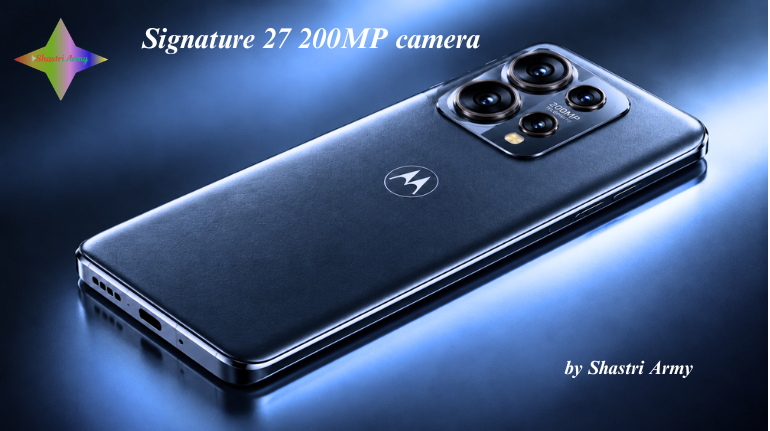
Motorola is taking a much more aggressive approach to smartphone photography with the Motorola Signature 27, and the camera system appears to be one of the biggest areas of change. The previous Motorola Signature already positioned itself as a premium camera phone, combining 50MP sensors, a periscope telephoto camera, Dolby Vision video and AI-powered image processing.
The Signature 27 takes that formula considerably further by introducing a 200MP periscope telephoto camera, a larger Sony LYTIA sensor for the main photography system and AI-powered zoom technology capable of reaching up to 100x.
That combination makes the new phone particularly interesting for people who care about photographing distant subjects, portraits, travel scenes, night environments and video. Motorola has also confirmed that the Motorola Signature 27 camera is being built around a next-generation flagship platform, giving its image-processing system substantially more computational power to work with.
The important question, however, is not simply whether a phone has 200MP written on its camera module. Megapixels are only one part of the photography equation. Sensor size, lens quality, stabilization, image processing, dynamic range, autofocus and computational photography all determine whether a high-resolution camera actually produces better photographs.
The Motorola Signature 27 camera therefore represents a potentially important step for Motorola because the company is combining high resolution with periscope optics and AI rather than relying on megapixel numbers alone.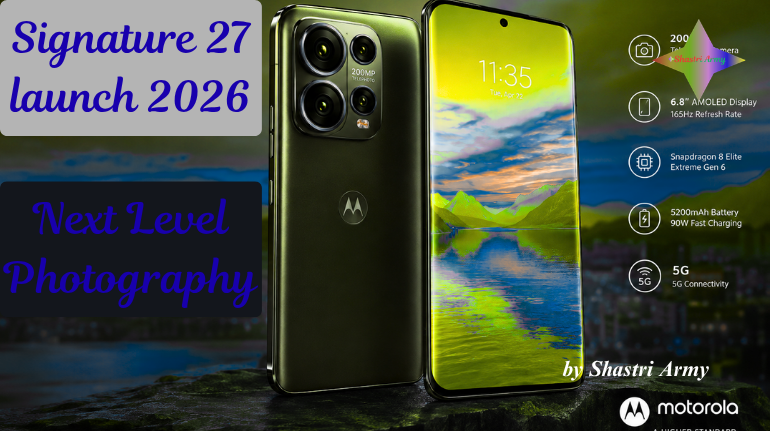
Motorola Signature 27 Camera: The Big Upgrade
The most obvious camera change is the move toward a 200MP periscope telephoto camera. Motorola’s current Signature 27 information specifically highlights a 200MP periscope telephoto system and Super Zoom Pro technology capable of reaching up to 100x with generative AI.
This is a very different approach from simply increasing the resolution of a conventional primary camera. A periscope camera uses folded optics inside the phone so that a longer optical path can fit into a relatively thin smartphone body.
That design gives the phone greater flexibility when photographing subjects that are far away. Imagine standing at the edge of a stadium, looking toward a performer on stage, or trying to photograph a building across a street. A conventional smartphone camera can quickly lose useful detail as digital zoom increases, while a properly designed telephoto system starts with genuine optical magnification before computational processing takes over.
The 200MP sensor gives Motorola an enormous amount of image data to work with, which can potentially help preserve detail when cropping or applying hybrid zoom techniques. At the same time, real-world results will depend on lighting, stabilization and processing. A 200MP specification alone does not automatically guarantee a better photograph than a smaller sensor with stronger optics and processing.
The interesting part of the Motorola Signature 27 camera is the combination of high-resolution capture, periscope optics and AI-assisted zoom.
From 50MP to a 200MP Camera
The jump from a 50MP camera to a 200MP telephoto system is one of the clearest differences between the original Signature and Motorola Signature 27 camera.
The first-generation Signature already used a 50MP main camera, 50MP ultra wide camera and 50MP telephoto camera, with Motorola promoting its Sony LYTIA 828 main sensor and a 50MP Sony LYTIA 600 periscope telephoto system.
The Motorola Signature 27 camera changes the emphasis by putting extremely high resolution into the long-range camera. This matters because telephoto photography is one of the areas where smartphones can struggle most. When a subject is distant, every bit of optical information becomes valuable.
A high-resolution sensor can give the processing engine more pixels from which to reconstruct fine details, especially when combined with a real telephoto lens. That can be useful for travel photography, architecture, sports, wildlife and portraits where moving physically closer is not always possible.
It also gives users greater flexibility after taking a photograph because a high-resolution frame can contain more information for cropping. Still, users should keep expectations realistic. At very high zoom levels, atmospheric haze, camera shake, subject movement and insufficient light can reduce image quality regardless of how many megapixels the sensor has.
Why Sensor Size Matters
One of the most interesting developments is that Motorola is not focusing only on resolution. Reports and Motorola’s promotional material indicate that the Signature 27’s camera system uses a Sony LYTIA 901 sensor with a 1/1.12-inch format for its major camera system.
Sensor size matters because larger sensors can collect more light, depending on the lens and pixel architecture. More captured light can help the camera maintain cleaner shadows, better colour information and lower noise, particularly in challenging environments. This becomes especially important when a smartphone is trying to preserve detail at night or in indoor scenes. Computational photography can compensate for many limitations, but it cannot completely replace the physical advantages of a capable sensor and lens. Motorola’s direction with the Motorola Signature 27 camera therefore appears to be a combination of hardware and software rather than a simple megapixel race.
A large sensor gives the imaging system more raw information, while AI processing can decide how that information should be transformed into a final photograph. The result could be more natural-looking images across a wider range of lighting conditions, although independent testing will ultimately be needed to determine how effectively the hardware performs in everyday use.
The New Sony LYTIA Camera Technology
Sony’s LYTIA family has become an important part of Motorola’s recent flagship camera strategy. The original Signature used the Sony LYTIA 828 for its main camera and the LYTIA 600 for its periscope telephoto camera. For the Motorola Signature 27 camera, Motorola has highlighted the Sony LYTIA 901 and an intelligent Video Enhancement Engine designed to improve exposure, colour, highlights and shadows in real time.
This is significant because smartphone cameras increasingly depend on image-processing pipelines rather than the sensor alone. When you take a picture against a bright window, for example, the camera has to decide whether to preserve the sky, brighten the person or balance both. Similar challenges appear during sunset photography, concerts and night street scenes.
A more sophisticated processing engine can analyse these situations and make adjustments before the final image is produced. Motorola’s stated approach suggests that the Signature 27 is designed to make those decisions automatically while still giving users a high-resolution camera system.
For everyday photographers, this can be more valuable than having complicated manual controls that require technical knowledge. The goal is essentially to make the camera smarter without making the user work harder.
100x Super Zoom Pro and Periscope Photography
The 100x Super Zoom Pro feature is another major part of Motorola Signature 27 camera story. Motorola says the system combines the 200MP periscope telephoto camera with generative AI to reach up to 100x zoom.
The phrase “100x” can sound dramatic, but it is important to understand what that number means. At extreme zoom levels, a smartphone is not simply magnifying an optically captured image. Computational photography becomes increasingly important because the camera has to reconstruct or enhance information that becomes difficult to capture directly.
This is where generative AI can play a role. Rather than treating digital zoom as simple pixel enlargement, the processing system can attempt to produce more coherent details based on the information available in the original frame.
The practical benefit will depend heavily on the subject and lighting conditions. A well-lit stationary building may produce a very different result from a moving person photographed at night. For that reason, 100x should be viewed as a capability rather than a guarantee of optical-quality detail at every distance. The more interesting question is how good the camera remains at intermediate zoom levels such as 3x, 5x, 10x and beyond, because those ranges are more likely to be used regularly.
How Motorola Is Approaching Long-Range Photography
Long-range photography is becoming one of the most competitive areas of smartphone camera development. Motorola Signature 27 camera approach combines periscope optics, very high sensor resolution and AI processing.
Each component addresses a different problem. The periscope provides optical reach, the 200MP sensor provides a large amount of image data, and AI processing attempts to improve the final image as the zoom level increases. Think of the system like a telescope combined with a computer rather than a simple digital magnifying glass.
The telescope provides the initial visual information, while the computer processes that information to make it more useful. This could make the Motorola Signature 27 camera particularly interesting for travelers and people who frequently photograph subjects that cannot be approached closely.
It could also help with portrait photography by providing longer focal lengths that produce more natural subject separation. However, stabilization becomes critical as magnification increases. Even tiny hand movements become much more visible at high zoom levels. The effectiveness of Motorola’s system will therefore depend not only on the 200MP sensor but also on autofocus, optical stabilization, shutter speed and AI processing.
AI Photography on the Motorola Signature 27
Artificial intelligence is becoming almost as important as the camera hardware itself, and Motorola is clearly making AI a central part of the Motorola Signature 27 camera experience. The phone’s camera system is designed to use AI to improve zoom and image processing, while Motorola’s broader software approach also emphasizes intelligent features.
AI photography can be useful because modern smartphone cameras need to solve several problems simultaneously. They need to recognize scenes, balance exposure, preserve skin tones, reduce noise, sharpen details and maintain natural colors without forcing the user to manually adjust settings.
A camera that can make those decisions quickly can make photography easier for ordinary users. The challenge is finding the right balance. Excessive sharpening can make photographs look artificial, while aggressive noise reduction can remove genuine texture. Similarly, generative AI can create visually pleasing results but may sometimes produce details that were not actually captured by the sensor. This makes transparency and user control increasingly important.
Motorola Signature 27 camera is therefore part of a broader shift where the smartphone camera is no longer just a lens and sensor; it is an intelligent imaging system that interprets the scene before delivering the final photograph.
Better Exposure, Colour and Detail
Motorola says the Signature 27’s Sony LYTIA 901 sensor works with an intelligent Video Enhancement Engine that can refine colour, exposure, highlights and shadows in real time. Those areas are especially important for difficult scenes.
Consider a photograph taken during sunset. The sky may be extremely bright while the foreground is dark, creating a situation where a conventional exposure can lose either the clouds or the details in the shadows. Computational processing can combine information and adjust the image so that the final photograph contains a more balanced range of tones.
The same concept applies to indoor scenes with bright windows, nighttime city streets and subjects illuminated by uneven artificial lighting. Colour processing also matters because accurate skin tones and natural-looking colors can make a photograph feel much more realistic.
Motorola’s challenge is to ensure that AI enhancement improves the scene without turning every photograph into an overly processed image. If the company can maintain that balance, the Motorola Signature 27 camera experience that feels fast and intelligent while still producing images that look believable.
Low-Light Photography Could Get a Major Boost
Low-light photography is one of the areas where sensor technology, lens design and computational photography have to work together. A smartphone cannot simply increase brightness without also increasing image noise, and long exposures can introduce blur when either the photographer or subject moves. A larger sensor can help capture more light, while advanced processing can combine multiple frames or intelligently reduce noise.
Motorola’s emphasis on the LYTIA 901 and AI-enhanced imaging suggests that low-light performance is an important part of the Motorola Signature 27 camera strategy. Night photography could particularly benefit from better highlight control because modern city environments contain bright signs, headlights and street lamps surrounded by dark areas.
A capable imaging system needs to retain detail in both regions rather than turning bright lights into large white patches. Moving subjects create another challenge because computational multi-frame processing can produce ghosting if frames are not aligned correctly.
This is why a genuinely strong night camera needs more than a large megapixel number. It needs fast autofocus, appropriate shutter speeds, optical stabilization and intelligent processing working together. Independent camera testing will ultimately show how well the Signature 27 handles these situations.
Night Photography and Moving Subjects
A beautiful night photograph is not necessarily the same thing as a sharp photograph of a moving subject at night. A stationary building can be captured using a longer exposure, giving the camera more time to collect light.
A moving person, however, can become blurred if the shutter stays open too long. Motorola’s AI-enhanced approach could help by identifying motion and adjusting capture settings accordingly.
The same principle applies to children, pets, vehicles and sports. In these situations, a camera needs to make decisions quickly because the photographer may have only one opportunity to capture the moment. A high-resolution sensor can provide plenty of information, but the camera software has to know when not to over-process the image.
The Signature 27’s combination of advanced hardware and computational photography could therefore be especially useful for spontaneous photography. Instead of asking users to understand shutter speed, ISO and exposure compensation, the phone can attempt to make those decisions automatically.
The real test will be consistency: not whether it produces one impressive night photograph, but whether it can deliver usable results across hundreds of ordinary nighttime situations.
Motorola Signature 27 Video Capabilities
Motorola is also positioning the Signature 27 as more than a still-photography device. The company has highlighted an intelligent Video Enhancement Engine, indicating that video processing is another major part of the imaging strategy. Video creates different challenges from photography because the camera has to maintain consistent exposure and colour across many frames rather than optimizing each frame independently.
A sudden change in brightness can make footage look unstable, while inconsistent colour between cameras can become obvious when switching from the main camera to an ultra wide or telephoto lens. Advanced processing can help smooth these transitions and preserve a more consistent visual appearance.
The Signature 27’s high-resolution camera hardware also gives it greater flexibility for cropping and reframing video, although actual video modes, stabilization performance and frame-rate options need to be evaluated in practical testing. Motorola has previously emphasized Dolby Vision on its Signature line, and the new generation continues the company’s focus on cinematic video capabilities.
For creators who shoot short-form content, travel videos or social media clips, the combination of strong cameras and AI processing could reduce the need for extensive editing after recording.
Ultrawide, Telephoto and Multi-Camera Flexibility
A flagship camera system is rarely about one lens. Different focal lengths serve different purposes, and a versatile smartphone needs to move smoothly between them.
Motorola’s original Signature used 50MP main, ultra wide and telephoto cameras, while the Signature 27 is taking a more ambitious approach with its high-resolution periscope system. An ultra wide camera is useful for architecture, landscapes and group photographs where the photographer cannot step backward far enough.
A standard main camera is generally the most flexible option for everyday scenes. A telephoto camera becomes valuable when the subject is distant or when the photographer wants a different perspective for portraits. A periscope telephoto extends that flexibility even further. The key is consistency. If each camera produces dramatically different colors or levels of detail, switching lenses can make the final content look inconsistent.
A well-integrated camera system should make the different lenses feel like parts of the same camera rather than separate devices. Motorola’s AI processing and color-management approach could be particularly important here because software can help maintain a consistent appearance across different sensors and focal lengths.
What the Signature 27 Could Mean for Mobile Photography
The Signature 27 shows how smartphone photography is moving beyond the traditional race for more megapixels. Resolution remains important, but modern flagship cameras are increasingly defined by the relationship between sensor size, optics, AI, stabilization and image processing.
Motorola’s approach is interesting because it puts a 200MP periscope camera at the center of the long-range photography experience while also introducing newer Sony LYTIA technology and AI-based processing. This creates a system designed to handle several photography scenarios rather than focusing on only one. For travelers, the ability to photograph distant architecture or landscapes could be particularly useful.
For creators, high-resolution cameras and advanced video processing could provide more flexibility during editing. For ordinary users, the biggest benefit may simply be getting a better photograph without needing to understand technical camera settings. The phone essentially becomes a pocket-sized computational photography system. The remaining question is how well Motorola has tuned the software.
Hardware specifications can tell us what a phone is capable of doing, but real photographs reveal whether those capabilities translate into consistent results.
Motorola Signature 27 Camera vs the Previous Signature
The differences between the two generations become clearer when their camera approaches are placed side by side.
| Camera Feature | Motorola Signature | Motorola Signature 27 |
|---|---|---|
| Main camera | 50MP | Sony LYTIA-based system with major sensor upgrade |
| Telephoto approach | 50MP periscope telephoto | 200MP periscope telephoto |
| Maximum advertised zoom | Up to 100x Super Zoom Pro | Up to 100x Super Zoom Pro with generative AI |
| AI imaging | Moto AI and image enhancement | Expanded AI-powered imaging and zoom |
| Video focus | Dolby Vision and high-resolution video | Enhanced video processing and AI-assisted imaging |
| Camera strategy | Balanced triple-camera system | Higher-resolution long-range photography |
| Processing platform | Snapdragon 8 Gen 5 | Snapdragon 8 Elite Extreme Gen 6 platform |
The table shows that Motorola is not simply replacing one component and keeping everything else identical. The Signature 27 appears to be designed around a stronger computational photography architecture.
Its 200MP periscope camera changes the role of the telephoto system, while the newer Sony LYTIA sensor and processing engine target image quality across different lighting conditions. The previous Signature was already positioned as a premium photography phone, so the new model has to improve not just specifications but consistency.
A camera can look impressive on a specification sheet and still produce disappointing results if processing is poorly tuned. Conversely, a well-balanced camera system can produce excellent photographs even without the largest numbers. That is why the Signature 27 will be particularly interesting to evaluate through real-world comparisons rather than specifications alone.
What Photographers Should Watch For
When the Signature 27 becomes available for broader hands-on testing, photographers should look beyond the headline 200MP number.
The most useful tests will involve daylight detail, portrait rendering, skin tones, dynamic range, low-light noise, moving subjects, autofocus speed and zoom consistency. Intermediate zoom levels deserve particular attention because these are likely to be used much more frequently than 100x.
It will also be useful to see how the 200MP periscope performs when the lighting becomes difficult. Another important test will involve switching between lenses during video recording because colour and exposure consistency can make a major difference to creators. AI-generated or enhanced details should also be examined carefully to determine whether they preserve natural textures or sometimes create artificial-looking patterns. These practical tests will tell users much more than a specification sheet.
The Signature 27 certainly has ambitious camera hardware, but its real value will depend on how effectively Motorola combines optics, sensors, stabilization and software into a reliable everyday camera.
Conclusion
The Motorola Signature 27 camera represents a substantial step in Motorola’s approach to premium smartphone photography. Its headline feature is the 200MP periscope telephoto camera, but the more important story is the combination of high resolution, Sony LYTIA sensor technology, AI-powered processing and 100x Super Zoom Pro.
Motorola is clearly focusing on long-range photography while also working to improve colour, exposure, detail and video processing. The move shows how modern smartphone cameras are becoming increasingly computational, with software playing an equally important role alongside physical camera hardware.
For users, this could mean greater flexibility when photographing distant subjects, challenging lighting conditions and fast-moving scenes. At the same time, the final judgement of image quality will depend on real-world testing rather than specifications alone. If Motorola can turn this powerful hardware into consistent, natural-looking photographs, the Signature 27 could become an important milestone in the company’s push into premium smartphone photography.
The camera story is therefore not simply about going from 50MP to 200MP; it is about combining more information with better optics and smarter processing to make a smartphone camera more capable in situations where previous generations struggled.
FAQs
1. What is the main camera highlight of the Motorola Signature 27?
The biggest camera highlight is the 200MP periscope telephoto camera. Motorola says the camera system supports Super Zoom Pro with up to 100x zoom using generative AI. The phone also uses advanced Sony LYTIA camera technology for its imaging system.
2. Does the Motorola Signature 27 have 100x zoom?
Yes. Motorola’s official Signature 27 information highlights up to 100x Super Zoom Pro. The system combines the high-resolution periscope camera with computational and generative AI processing. Image quality at different zoom levels will naturally vary depending on lighting, distance and subject movement.
3. Is 200MP automatically better than 50MP?
Not necessarily. Megapixel count is only one part of camera quality. Sensor size, lens quality, stabilization, autofocus, dynamic range and image processing all influence the final photograph. A 200MP sensor can provide more image information, but software and optics determine how effectively that information is used.
4. Can the Motorola Signature 27 be useful for video creators?
The Signature 27 is designed with video processing in mind, including an intelligent Video Enhancement Engine. Motorola has emphasized improvements involving exposure, colour, highlights and shadows. Actual video quality should be judged through hands-on testing of stabilization, autofocus, dynamic range and available recording modes.
5. How is the Signature 27 different from the original Motorola Signature?
The original Signature used a 50MP main camera, 50MP ultra wide and 50MP telephoto/periscope system. The Signature 27 moves to a much higher-resolution 200MP periscope telephoto camera and newer Sony LYTIA technology, while expanding the role of AI-powered imaging and zoom processing.